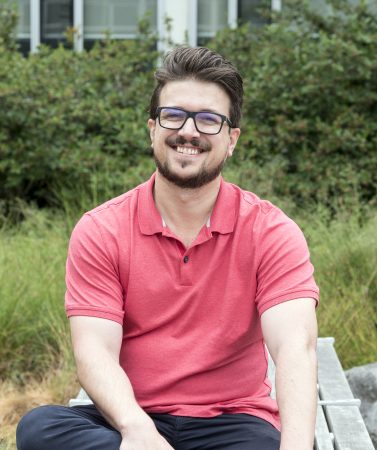
David Gaertner
Program Area
About
David Gaertner researches how generative AI turns language, memory, and relation into extractable resources—and what Indigenous literatures make visible about that process. His current work grows from more than a decade of research and practice in Indigenous new media, digital infrastructure, and data sovereignty. Drawing on Indigenous theory, critical data studies, and media theory, he connects large language models to longer histories of colonial extraction. He is especially interested in the forms of relief, attachment, and vulnerability these systems produce. A settler scholar of German descent, Gaertner is an Associate Professor in the Institute for Critical Indigenous Studies and an Associate Member of the Department of English Language and Literatures.
His current book project, Mining Interiority: Relief, Memory, and Relational Capture in Generative AI, examines how conversational AI constructs working versions of its users from the traces they leave behind. He writes about this research—and about what happens when questions of writing, interpretation, memory, and relation meet new machines—at Trace and Address (www.traceandaddress.ca). His forthcoming chapter, “The Alignment Problem: Reading Indigenous Literatures after AI,” will appear with Bloomsbury.
Much of Gaertner’s research is community-based and collaborative. His projects bring artists, students, and community partners together to explore how digital media can support storytelling, language, and sovereignty. These include Kw’í:ts’téleq: The Video Game, created with the Stó:lō Xwexwílmexw Government, and a video-poetry project with Musqueam artist Debra Sparrow, Fiona Tinwei Lam (then Vancouver’s Poet Laureate), and students in FNIS 454, which premiered at a public screening and earned two awards in the City of Vancouver’s City Poems contest. He is a research collaborator with the Union of British Columbia Indian Chiefs on Threads of Resistance, a digital gallery designed around Indigenous data sovereignty, and co-founder of #HonouringIndigenousWriters, an annual edit-athon and reading series; his article on the latter received the 2026 Beatrice Medicine Award for Scholarship in American Indian Studies.
Gaertner is the author of The Theatre of Regret: Art, Literature, and the Politics of Reconciliation in Canada (UBC Press), editor of Sôhkêyihta: The Poetry of Sky Dancer Louise Bernice Halfe, and co-editor of Read, Listen, Tell: Indigenous Literature from Turtle Island and the forthcoming Indigenous X: Networks of Relations and Resistance on and Beyond Native Twitter (all Wilfrid Laurier University Press). He is Associate Editor and new media curator at BC Studies and a past President of the Indigenous Literary Studies Association.
He designed CIS’s new media and digital storytelling courses and supervises graduate students working on Indigenous literatures and digital media, sovereignty, and representation. He welcomes inquiries from prospective students in these areas.
Teaching
Publications
Featured Publications
Gaertner, David, ed. Soykeyihta: The Poetry of Sky Dancer Louise Bernice Halfe. Wilfrid Laurier University Press.
Gaertner, David, The Theatre of Regret: Art, Literature, and the Politics of Reconciliation in Canada. UBC Press, 2020.
Gaertner, David. Melissa Habrel and Autumn Schnell. Recoding Relations: A Four-Part Podcast Series on Indigenous New Media
Gaertner, David. Elizabeth Lapenseé and Karyn Recollet. “Indigenous.” Digital Pedagogy in the Humanities. Eds. Rebecca Frost Davis, Matthew K. Gold, Katherine D. Harris, and Jentery Sayers. Modern Language Association, 2020.
Peer-Reviewed
“Towards a Pedagogy of Closure: The Open Access Debate in Indigenous Studies.” Handbook of Digital Humanities. New York: Routledge (forthcoming).
“Fish Scales, Dark Matter, and Radical Relationality: Conceptualizing Consent in Augmented Reality” Co-authored with Karyn Recollet. In the Contemporary Indigenous Dance Anthology. University of California, Riverside (forthcoming).
“Indigenous Digital Pedagogy.” Co-authored with Karyn Recollet. Digital Pedagogy in the Humanities: Concepts, Models, and Experiments. Modern Language Association, 2018. https://github.com/curateteaching/digitalpedagogy/blob/master/keywords/indigenous.md
“Indigenous in Cyberspace: CyberPowWow, God’s Lake Narrows and the Challenges of Creating Indigenous Territory in Cyberspace.” American Indian Culture and Research Journal 39.4 (2015): 55-78.
“A Landless Territory: How Do We Articulate Cyberspace within the context of Indigenous Studies?” Learn, Teach, Challenge: Approaches to Indigenous Literatures in the 21st Century. Eds. Linda Morra & Deanna Reder. Waterloo: Wilfred Laurier UP. 493-498.
“‘Something in between’: Monkey Beach and the Haisla Return of the Repressed.” Canadian Literature 225 (Summer, 2015): 47-65.
“sehtoskakew: ‘Aboriginal Principles of Witnessing’ and the Canadian Truth and Reconciliation Commission.” The Arts of Engagement: Taking Aesthetic Action in and Around the Truth and Reconciliation Commission of Canada. Eds. Keavy Martin and Dylan Robinson. Waterloo: Wilfred Laurier Press, 2015. 135-156.
“Translating Reconciliation.” Translation Effects: The Shaping of Modern Canadian Culture. Eds. Louise von Flotow, Sherry Simon and Kathy Mezei. Ottawa: McGill-Queens University Press, 2014. 444-57.
“‘Redress as a Gift’: Historical Reparations and the Logic of the Gift in Roy Miki’s
Redress.” In Tracing the Lines: A Symposium to Honour Roy Miki. Eds. Christine Kim, Maia Joseph, Larissa Lai, and Chris Lee. Vancouver: Talonbooks, 2013. 67-75.
“Here Comes the Neighbourhood: Encountering the Problem of the Neighbour in Space.” Co-authored with Jason Starnes. West Coast Line 73 64 (2012): 4-9.
“Performing Neighbourhoods: an Interview with the Creators of PodPlays.” West Coast Line 73 64 (2012): 38-43.
“‘The Climax of Reconciliation’: Transgression, Apology, Forgiveness and the Body in Conflict Resolution.” Bioethical Enquiry 1.1 (2011): 245-56.
“Labour, TAships and the Gift.” English Studies in Canada 35.4 (2011): 14-19.
“‘The Magical Power of Words’: Font and Ideology in Western Newspapers.” SHIFT 1.1 (2008): 1-17.
Monographs
The Theatre of Regret: Troubling Reconciliation in Canada. UBC Press (in production).
Anthologies
Sôhkêyihta: The Poetry of Sky Dancer Louise Bernice Halfe. Selected with an introduction by David Gaertner. Wilfrid Laurier University Press, 2018.
Read, Listen, Tell: Indigenous Literature From Turtle Island. Eds. Sophie McCall, Deanna
Reder, David Gaertner, Gabrielle Hill. Wilfred Laurier UP, 2017.
Commissioned Writing
“Back to the Future: Sovereignty and Remediation in Skawennati’s Timetraveller™”.
Commissioned by the Dunlop Art Gallery. Regina, Saskatchewan. October, 2015.
Digital Interventions
Novel Alliances: Allied Perspectives on Indigenous, Art, Politics, and New Media. Novel Alliances is a blog featuring short articles, notes, and resources on Indigenous media, culture, and politics. Since I launched it in 2013, Novel Alliances has hosted nearly 10,000 unique visitors and hosted content written and produced by FNIS students. https://novelalliances.com/about/
Never Alone: Resources and Reflections: I designed this website as a resource for students and researchers investigating the Inupiat video game Never Alone. It features links to resources for the game and the Inupiat community as well as essays by Indigenous studies scholars produced specifically for the site. A number of professors now use the website in their classes and I continue to add essays and resources written by colleagues and students. https://ilsaneveralone.wordpress.com/
Symposium for Indigenous New Media. This website was created as a resource for the Indigenous New Media Symposium, a two-day event held on the traditional territory of the WSÁNEĆ (Saanich), Lkwungen (Songhees), Wyomilth (Esquimalt) peoples of the Coast Salish Nation as part of the 2018 Digital Humanities Summer Institute (DHSI). The symposium was a starting point for an extensive capacity building and knowledge mobilization project at DHSI that will include the production of best practice materials and models to support Indigenous peoples and research in the digital humanities (DH). It remains online as a resource for students and researchers: https://indigenousnewmedia.wordpress.com