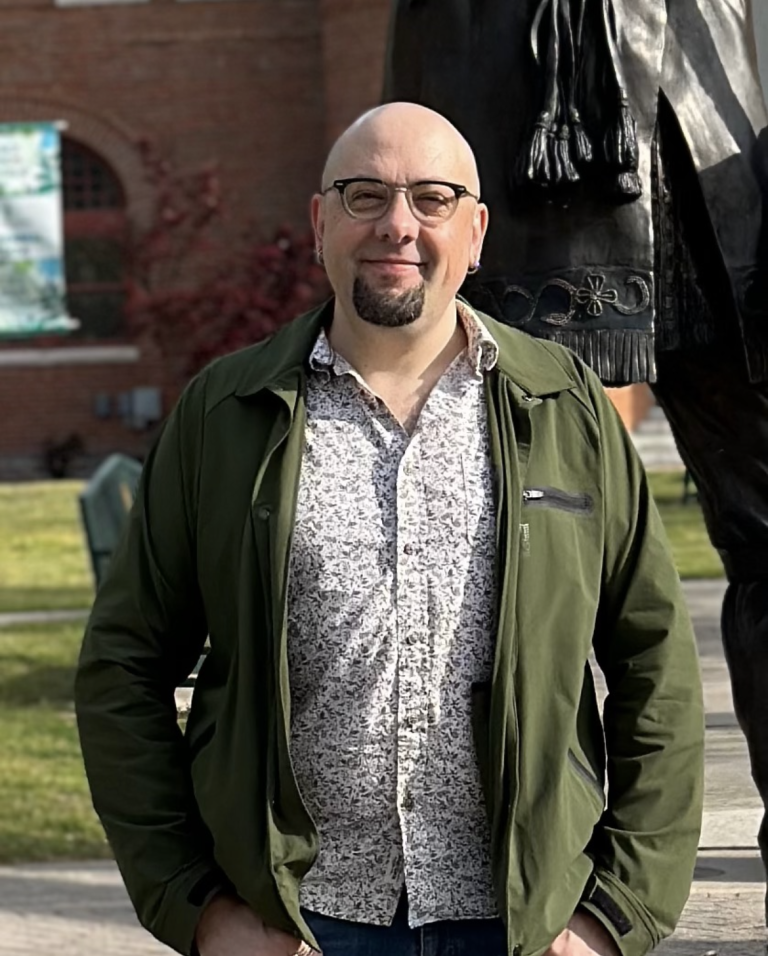



Daniel Heath Justice, enrolled citizen, Cherokee Nation
In this reflection, Daniel Heath Justice looks back on his 2006 book Our Fire Survives the Storm: A Cherokee Literary History and explains why he undertook a substantial revision for its twentieth-anniversary edition. Justice reflects on changing understandings of Cherokee identity, citizenship, and sovereignty, and the responsibilities of scholarship.
My first academic book was Our Fire Survives the Storm: A Cherokee Literary History, published by the University of Minnesota Press in 2006. It was the first academic book focused exclusively on Cherokee writing, with particular attention to the ways our social and political history informed the Cherokee literary tradition.
The book was firmly in the theoretical mode of what we now call Indigenous literary nationalism, which centres Indigenous perspectives, histories, and ideas in literary works by Indigenous writers. Dominant interpretive approaches at the time emphasized non-Indigenous influences and methods or privileged the idea of “hybridity,” both of which pushed Indigenous creative, cultural, and political concerns to the margins. Our Fire was part of that discussion, and at the time I was really proud of the contribution it made.
Unfortunately, I soon started to hear concerns from other Cherokees about who I identified as Cherokee in the book. At the time, I prioritized self-identification to define Cherokee belonging. Over half of the writers I featured in the book were unsubstantiated claimants—they had vague family stories of Cherokee ancestry but no relationship to any of the three federally recognized Cherokee Tribal Nations. This untethered inclusivity reinforced the public idea that Cherokee identity is rooted in vague family stories rather than verifiable relationships to a Cherokee community.
This matters, because hundreds of thousands of people claim to be Cherokee who aren’t connected to any of our Nations, and many of these people peddle misinformation and claiming cultural authority without accountability to Cherokee people or our Nations. We have some of the best records in the world documenting our social and political relations, so claims that someone’s ancestors weren’t “on the rolls” are largely either ill-informed or manifestly false.
To date, none of the noncitizen claimants I wrote about have substantiated their heritage claims, and some (like Thomas King) are now known to be non-Cherokee. That’s a major problem for a book supposedly dedicated to Cherokee intellectual and creative sovereignty.
As the years went on and my own attitude toward self-identification changed, I saw the harm that the book was doing in the world, and all the love and optimism I’d once had for the project became tinged with embarrassment, anger, and grief. What saddened me most was that other Cherokees found the book to be problematic and harmful too. Given that Cherokees were my core audience, it was clear that I had to address these issues and undo the harm as best I could.
A Revised Edition
In 2023, at the suggestion of my longtime friend Domino Perez, I reached out to my editor Jason Weidemann and asked him what the possibility would be to do a new and completely revised twentieth-anniversary edition that foregrounded Cherokee citizenship and removed all the problematic writers and texts from the discussion.
His was supportive, especially as, to his knowledge, it hadn’t been done before. He called it an exercise in “reparative publishing,” and both he and the Press gave it their full blessing and, importantly, invested the necessary resources to make it happen.
It took me over a year to revisit, revise, rewrite, and expand the book. I cut one chapter entirely, as it was the most compromised by unsubstantiated claimant writers, and significantly rearranged and expanded another. I added a new chapter on Cherokee futurisms, expanded the terminology section, and included a substantial new introduction that discussed the book’s journey and the intellectual and ethical commitment to Cherokee citizenship throughout.
The new version is officially the “citizenship and sovereignty edition,” as those are now the two key pillars of the book. I’ve done my best to ensure that everyone who’s cited as a Cherokee is a confirmed citizen of either the Cherokee Nation, the Eastern Band of Cherokee Indians, or the United Keetoowah Band of Cherokee Indians, and I’ve brought that citizenship focus throughout to all cited writers from other Nations. Citizenship is the guiding standard here.
I know that not everyone will be happy with this approach or why I’ve chosen to highlight citizenship over self-identification, yet I firmly believe that this is the most intellectually and ethically defensible option given where we are in these matters today.
Although I’d be happy to know that non-Cherokee readers find value in it, my greatest hope is that other Cherokees find it to be a meaningful contribution. If it does, then it will finally be the book I’d always hoped it would be.